Thailand-Cambodia Border Clashes Resume Amid Disputed Claims and Fragile Ceasefire
Lead
Fighting has resumed along the Thailand-Cambodia border despite repeated ceasefire announcements, highlighting how disputed claims, expanding military domains, and weak verification mechanisms are driving a conflict that no longer resembles earlier flare-ups. What began as a localized skirmish near the Preah Vihear temple complex in May has escalated into air strikes, rocket fire, maritime interdictions, and large-scale civilian evacuations. Both sides frame their actions as defensive, while accountability remains contested.
What Happened and Where
On 28 May 2025, a skirmish near the Preah Vihear temple complex left a Cambodian soldier dead, with Bangkok and Phnom Penh accusing each other of firing first. The incident reignited a long-standing dispute rooted in colonial-era boundary ambiguities and unresolved sovereignty claims.
Tensions escalated through June as Cambodia restricted Thai goods and Thailand tightened border crossings, utilities, and movement. A leaked phone call between Thai Prime Minister Paetongtarn Shinawatra and former Cambodian leader Hun Sen further destabilized Thai domestic politics, contributing to Paetongtarn’s suspension and weakening Bangkok’s internal consensus on de-escalation.
Between 23 and 28 July, violence spread across at least 12 border locations, including areas near Ta Muen Thom. Artillery exchanges and Thai air strikes were reported, with civilian areas affected and large-scale evacuations underway on both sides. A ceasefire announced on 28 July in Kuala Lumpur, mediated by Malaysia and encouraged by the United States and China, temporarily halted hostilities.
However, the truce proved short-lived. In November, Thailand suspended the ceasefire following landmine incidents that injured its soldiers. By early December, major clashes had resumed, involving air strikes, rocket fire, and expanded evacuations, with both governments accusing each other of deliberate escalation.
Why This Matters Now
Unlike earlier Thailand-Cambodia confrontations, the 2025 escalation coincides with domestic political instability, hardened nationalist rhetoric, and visible military posturing across multiple domains. Both governments deny responsibility for civilian harm while presenting their actions as proportionate responses to provocation, creating a narrative symmetry that obscures accountability and complicates mediation.
Repeated ceasefire collapses, disputed landmine incidents, and the widening scope of military operations suggest a shift from symbolic border friction toward sustained military risk. While regional actors continue to urge restraint, the conflict’s trajectory increasingly depends on domestic political incentives and the credibility of de-escalation mechanisms on the ground.
Escalation Thresholds Crossed
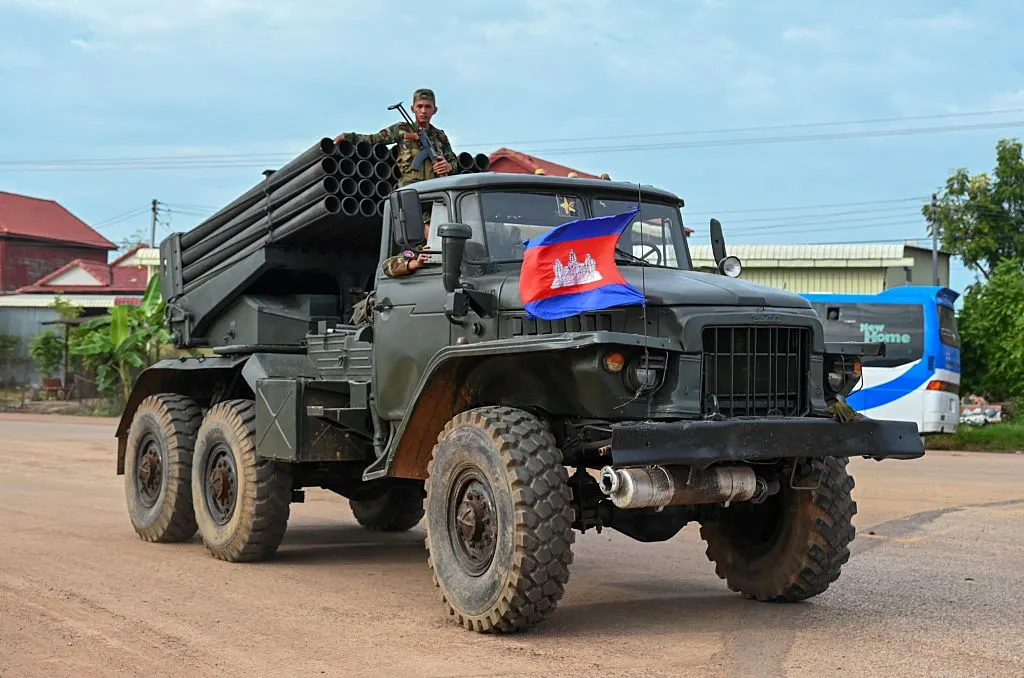
Several thresholds absent from earlier flare-ups have now been crossed. Thailand has acknowledged deploying F-16 fighter jets for cross-border strikes, including attacks on warehouses, bridges, and logistical sites. Cambodian forces, meanwhile, have used BM-21 Grad multiple rocket launchers capable of firing large salvos in short intervals.
The conflict has also entered the maritime domain, with Thailand’s navy intercepting vessels in the Gulf of Thailand suspected of supplying Cambodia. Combined with mass evacuations displacing hundreds of thousands of civilians, these developments mark a qualitative shift in how both sides are willing to use force.
Geographic Expansion: From Temples to Trade Routes
Fighting has spread well beyond contested temple zones such as Preah Vihear and Ta Muen Thom. Security measures now affect Thai provinces including Sisaket, Surin, and Ubon Ratchathani, as well as Cambodian border regions and urban nodes like Poipet, a key trade and casino hub linking the two countries.
Naval enforcement operations in the Gulf of Thailand further expand the conflict’s geographic scope, raising the risk of regional spillover and disrupting trade routes, energy infrastructure, and civilian mobility.
Disputed Claims and Information Warfare
Official narratives diverge sharply. Thailand maintains that its air strikes targeted military facilities on the outskirts of populated areas to neutralize rocket storage sites. Cambodian authorities counter that Thai jets bombed civilian neighborhoods, including areas near commercial and residential infrastructure.
International reporting reflects this divide. Thai statements emphasize precision and self-defense, while Cambodian messaging highlights sovereignty violations and civilian harm. Multilateral bodies, including the United Nations, have employed carefully neutral language, expressing concern and urging restraint without signaling enforcement, underscoring the limits of external pressure.
Cambodian state-aligned media has released detailed battlefield accounts and casualty figures portraying Poipet as a heavily bombarded civilian center. Many of these claims, including reports of mass military casualties and widespread destruction, cannot be independently verified through open-source imagery or third-party reporting, illustrating the conflict’s information warfare dimension.
What Can Be Verified and What Cannot
Certain developments are independently verifiable through multiple sources, including Thai-announced naval interdictions, border closures, evacuation orders, and broad casualty and displacement ranges reported by international media.
Other claims remain contested or unverifiable through open sources, including whether civilian structures were used as military command posts, the precise intent behind air-strike targeting decisions, and reports of Cambodian drones threatening offshore energy platforms. These verification gaps reflect both access constraints and deliberate narrative framing by all parties involved.
Humanitarian Impact
The humanitarian toll continues to rise. Thai media report at least 21 soldiers killed since early December, along with civilian deaths linked directly and indirectly to the fighting. Cambodian authorities report 18 civilian fatalities and dozens injured, while withholding military casualty figures.
Displacement estimates range from hundreds of thousands to nearly 800,000 people. Repeated evacuations have compounded trauma, particularly for migrant workers and cross-border communities as trade routes and labor flows remain disrupted.
OSINT Verification: Poipet Airstrike (December 2025)
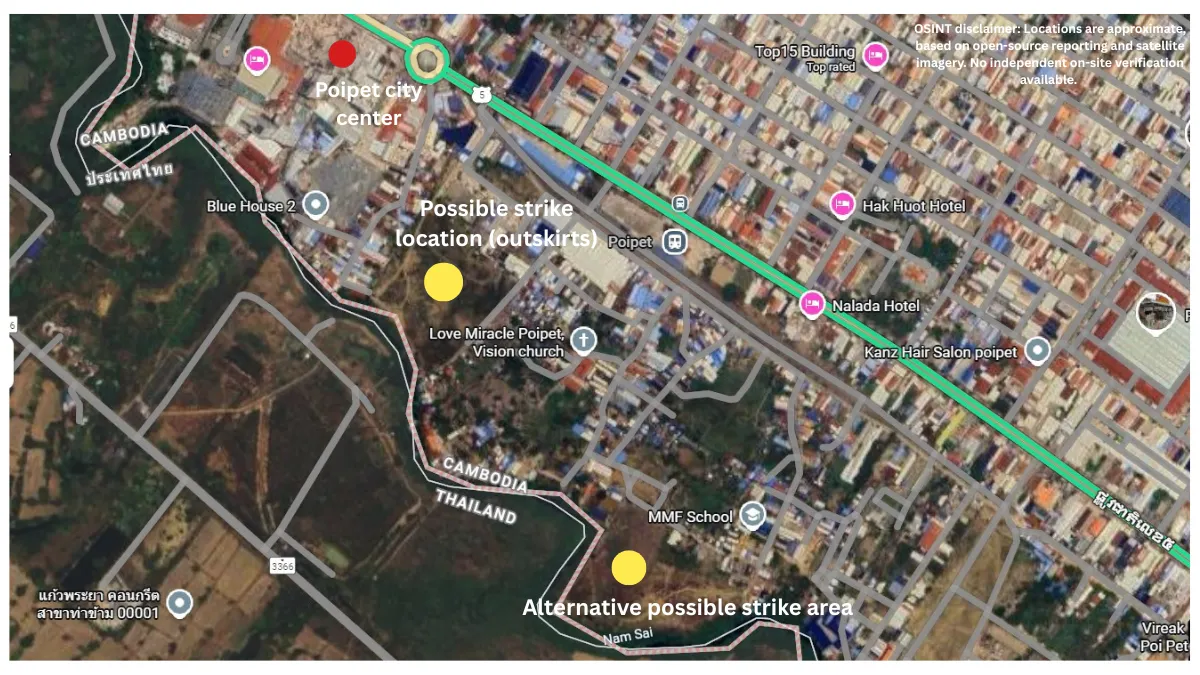
Open-source analysis was conducted on the reported Thai air strike near Poipet, a key border city and commercial hub. Cambodian authorities claimed Thai F-16 jets bombed civilian areas in central Poipet, while Thailand stated the strikes targeted military infrastructure on the city’s outskirts.
Damage patterns observed in available visuals are consistent with air-delivered munitions deployed by fast-jet aircraft, aligning with Thailand’s acknowledgment of F-16 involvement. However, open sources cannot independently verify Thai claims that the targeted structure was a military warehouse storing BM-21 rockets, nor Cambodia’s assertion that civilian neighborhoods were deliberately struck.
Open-source mapping identifies two low-density areas in southern Poipet consistent with descriptions of strikes on the city’s outskirts. Both locations feature sparse building density, road access, and distance from the dense border-casino zone. Due to the absence of verified geolocated footage, it is not possible to conclusively determine which site was struck, though both align with official statements that the target lay outside the city center.
Conclusion
The 2025 escalation along the Thailand-Cambodia border illustrates how unresolved territorial disputes can evolve into multidomain conflicts when political fragility, nationalist sentiment, and military modernization intersect. What began as localized clashes has expanded into air and maritime operations and mass civilian displacement, without the presence of a credible monitoring or enforcement mechanism.
As competing narratives continue to outpace verifiable evidence, the risk of miscalculation remains high. Without confidence-building measures paired with neutral verification, the conflict is likely to persist as a cycle of temporary lulls punctuated by renewed violence, leaving the border a persistent flashpoint for regional instability.