The Yellow Sea Stand-off and Escalating Sino-Korean Maritime Tensions
Introduction
A recent report by the Washington-based Center for Strategic and International Studies (CSIS) has revealed a tense 15-hour maritime standoff in the Yellow Sea between vessels from the China Coast Guard (CCG) and South Korean government ships. The Yellow Sea is a shallow, semi-enclosed basin bordered by mainland China to the west and north, and the Korean Peninsula (North and South Korea) to the east. This incident showcases Beijing’s persistent use of “gray zone” tactics to assert de facto control in contested waters, escalating geopolitical tensions between the two East Asian neighbors.
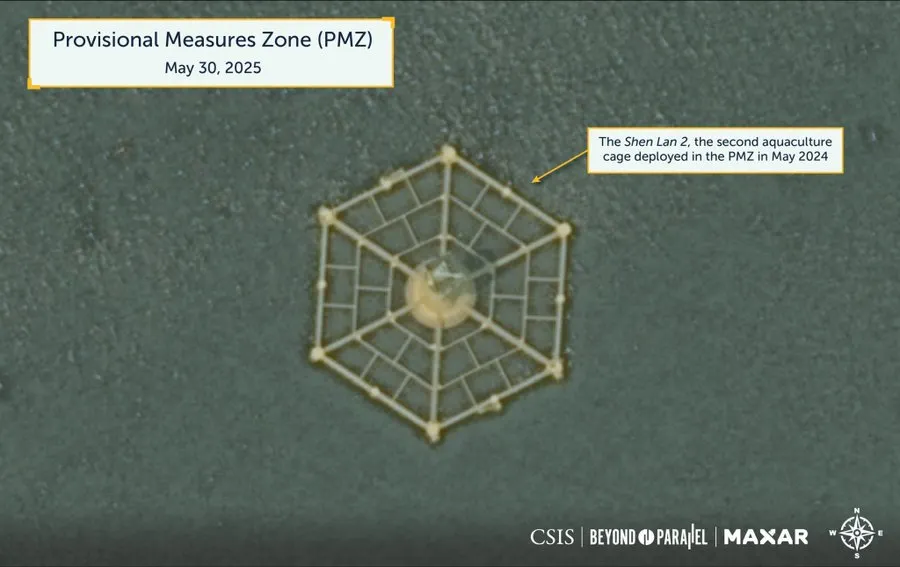
The Incident: A 15-Hour Standoff
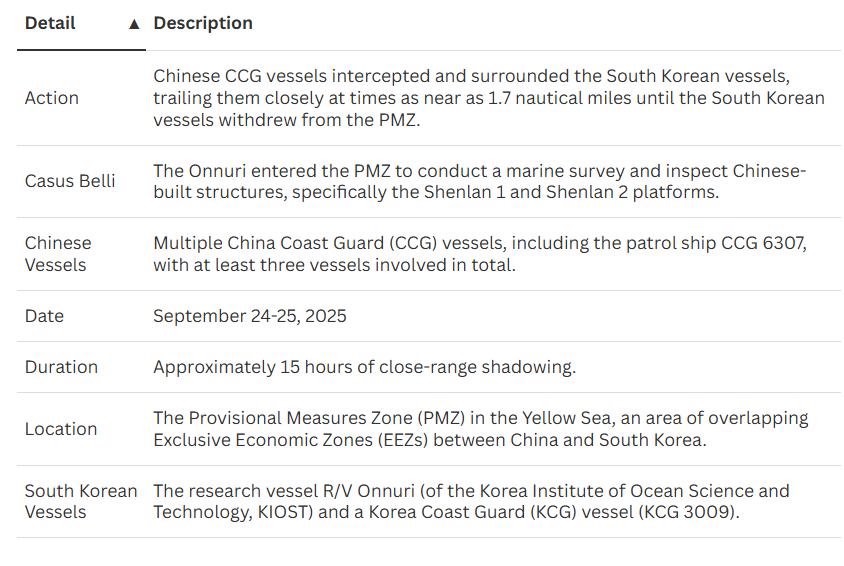
The confrontation began on September 24, when the R/V Onnuri entered the PMZ. It was quickly approached by CCG vessels and followed in its movements. The core of the standoff took place on September 25, when the Onnuri and its KCG escort neared two massive steel aquaculture platforms, Shenlan 1 and Shenlan 2, which China has unilaterally installed in the PMZ. China claims these structures are purely for deep-sea aquaculture, but Seoul views them as potential dual-use installations intended to expand Beijing’s strategic influence toward future territorial claims.
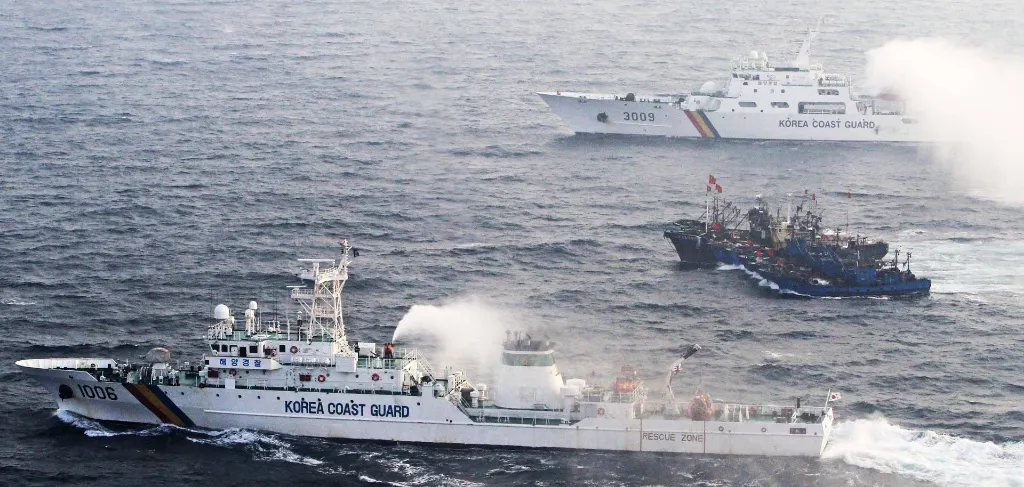
Geopolitical and Legal Context
The PMZ was established by a 2001 agreement between China and South Korea to jointly manage the Yellow Sea’s resources; a final demarcation of their EEZs is still pending. The agreement restricts non-fishing and non-navigation activities.
- China’s Position: Beijing insists the steel structures are for legitimate aquaculture purposes and comply with its domestic law. While a South Korean government official later suggested the Onnuri’s mission was a “regular marine survey” and denied “direct obstruction,” the CCG’s actions clearly demonstrated an intent to restrict access to the structures.
- South Korea’s Position: Seoul maintains that the deployment of these large, permanent platforms, which resemble oil rigs and observation buoys, violates the spirit of the PMZ agreement by being installed without prior consultation. South Korean research activities in its claimed EEZ are considered legitimate. The latest standoff marks the second such incident in seven months, following a similar confrontation in February, indicating a growing and consistent pattern of Chinese assertiveness.
- Legal Violations and Gray Zone Tactics: The CSIS report explicitly states that China’s attempts to restrict the navigation of South Korean vessels in the PMZ, particularly a research vessel, clearly violate the United Nations Convention on the Law of the Sea (UNCLOS), which guarantees freedom of navigation for all vessels within an EEZ. China’s strategy — using its massive coast guard fleet to consistently patrol, shadow, and physically intimidate foreign vessels without resorting to overt military conflict — is a hallmark of the “gray zone” tactics it has successfully employed in the South and East China Seas to solidify its control over disputed areas.
Implications and Regional Outlook
This incident carries serious geopolitical implications for Northeast Asia:
- Asserting De Facto Control: China’s persistent interference — with 27 out of 135 South Korean maritime surveys since 2020 reporting interference — suggests a deliberate strategy to establish de facto control over the PMZ and push its maritime boundary claims further eastward. Beijing is normalizing its presence and surveillance activities around its unilaterally deployed structures.
- Challenge to the ROK-U.S. Alliance: The site of the standoff is geographically close to the U.S. military base in Pyeongtaek. South Korean Foreign Minister Cho Hyun-dong acknowledged the proximity and confirmed that the United States is monitoring the situation seriously, suggesting that Seoul may consider cooperating with Washington to counter Chinese pressure. The escalation in the Yellow Sea directly complicates ROK-U.S. security coordination and joint naval operations.
- Future Countermeasures: South Korea is under pressure to develop a more robust response. Options include increasing its own coast guard and naval deployments to the PMZ or considering the installation of a “necessary facility” in the disputed waters as a proportional countermeasure to China’s structures, further risking an arms race in the Yellow Sea.
In conclusion, the 15-hour standoff in the Yellow Sea is not an isolated event but a manifestation of China’s broader, coercive maritime strategy. By using its coast guard to enforce unilateral claims over a jointly managed zone, Beijing is testing Seoul’s resolve and the cohesion of its alliances, pushing the Yellow Sea toward greater instability and transforming what was intended as a zone of cooperation into a new flashpoint for geopolitical rivalry.
References
- Jun, J., & Cha, V. (2025, October 27). Korea-China standoffs in the PMZ. Beyond Parallel, Center for Strategic and International Studies. Retrieved from https://beyondparallel.csis.org/korea-china-standoffs-in-the-pmz/
- Choi, S. H. (2025, October 29). China, South Korean vessels in 15-hour Yellow Sea stand-off last month, report reveals. South China Morning Post. Retrieved from https://www.scmp.com/news/china/military/article/3330644/china-south-korean-vessels-15-hour-yellow-sea-stand-last-month-report-reveals
- IANS. (2025, October 28). Chinese Coast Guard, S. Korea in Yellow Sea standoff: CSIS. NE India. Retrieved from https://neindia.com/chinese-coast-guard-s-korea-in-yellow-sea-standoff-csis/
- The Star. (2025, November 1). China, South Korean ships in 15-hour Yellow Sea stand-off last month: report. Retrieved from https://www.thestar.com.my/aseanplus/aseanplus-news/2025/11/01/china-south-korean-ships-in-15-hour-yellow-sea-stand-off-last-month-report#goog_rewarded